
Posts Tagged ‘book review’

Idyllic childhood days

Monday, April 8th, 2013

Piano Rock: A 1950s Childhood by Gavin Bishop

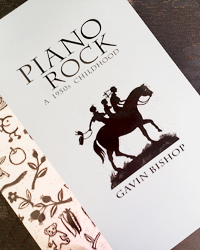
Piano Rock: A 1950s Childhood
By Gavin Bishop · Reviewed by Anne Mortimer

With a “to be read” queue that will take me easily into retirement, Piano Rock immediately drew me in thanks to the beautiful silhouettes, line drawings and watercolour illustrations that pepper the bite-sized chapters. However more importantly, this was 1950s spelt correctly, with no superfluous apostrophes thank you very much.

Piano Rock tells the story of Gavin Bishop’s 1950s childhood, growing up in Kingston beside Lake Wakatipu. Each chapter offers a snapshot of life and the variety of memorable happenings that shaped Gavin’s childhood between the ages of four and eight, beginning with the Bishop family’s journey via goods train from Invercargill to Kingston sitting on their couch in the guard’s van with the doors open taking in all of the scenery. Despite the different time period, the themes covered are ones that younger readers can associate with, or imagine: looking forward to visits from Grandma; learning to swim; an out of the ordinary school outing in the back of a  farm truck to the Nevis Valley; the arrival of a new baby brother and the impact that has on an older child.

Piano Rock: A 1950s Childhood by Gavin Bishop

Piano Rock: A 1950s Childhood by Gavin Bishop

I particularly enjoyed the description of the food, which is all very “matter of fact”. The baking of girdle scones was a Sunday ritual and a recipe is included for readers to try. Mrs Bishop’s traditional fare was influenced by the neighbouring Greek and Romanian families. This really struck me as my mother’s cooking didn’t take on any cosmopolitan influence until the late 1970s. I remember thinking how experimental my friend’s mam was because she cooked spaghetti bolognaise and such like when we were faced with leek pudding and neck chops with barley! Piano Rock draws to a close with the dramatic recollection of a bonfire on Guy Fawkes Night through the eyes of a small boy. The tale is neatly brought to a close, with Gavin reflecting upon a family photo, which mirrors the start of the book as the Bishop family prepare to leave Kingston for Invercargill in 1954.

I have re-read the book with Miss X who often asks me tell her about “the olden days” or, a story from when I was little. Piano Rock offers younger readers an affectionate reminiscence of a 1950s childhood, ably assisted with delightful illustrations and a handy-dandy glossary in the back.

Anne Mortimer is a sometime mum and sometime administrator. She also makes handcrafted felt items and will occasionally sell these. Anne has worked for museums, galleries and libraries in the UK and settled in New Zealand four years ago.

The Art of Handmade Living

Monday, March 11th, 2013

Cover of The Art of Handmade Living by Willow Crossley

The Art of Handmade Living: Crafting a beautiful home
By Willow Crossley · Reviewed by Katy McRae

Things got off to a good start with this book, when I read in the introduction that Willow has a son called Wolf. I also have a son called Wolf(gang), so I liked her immediately. However, I endeavoured not to let her good taste in naming her offspring bias me as I progressed through the rest of her book. I tried to be impartial and, to be honest, it wasn’t hard as having sons with the same name is pretty much where our similarities end.
 
It’s fair to say that Willow’s aesthetic is not minimalist. In her own words, “I don’t really make things that anyone might need, just things that enhance your life (or at least the way it looks).” She appears to be on a one-woman mission to decorate the bejesus out of everything. Nothing is safe or sacred. House pegs are zhushed up with washi paper, coat hangers get a fabric face-lift and no lampshade is complete if it isn’t festooned with ribbon and finished off with pom-pom trim.
 
I’m all for adding personal touches to things but Willow can be, at times, a bit excessive in her determination to beautify everything she touches. Case in point – ‘decorative sticks’. To clarify, these are sticks that have thread wrapped around them. As Willow herself acknowledges, “They don’t do anything or have any secret purpose. They are purely decorative.”
 
Realistically, I don’t think decorative sticks would have a place in my home but I do have a respect for the way Willow is determined to transform the mundane, the functional and the downright useless into things of beauty. She is a firm believer that functionality does not have to be at the expense of form.

Page spread from The Art of Handmade Living by Willow Crossley

Page spread from The Art of Handmade Living by Willow Crossley
 
The book is divided into four chapters – ‘To Decorate’, ‘To Hang’, ‘To Use’ and ‘To Nest’ – though really they are all ‘to decorate’. In the introduction she makes a point of saying that you don’t need to be a technical whiz or expert stitcher to be able to make the projects in the book, and she isn’t kidding. Some of these projects really are super, super simple. For example, putting a ribbon band on a hat (though she does include some handy hints on how to hide the join) or sticking felt to the back of an old tile to make a heatproof kitchen coaster. There are, however, some slightly more involved projects, particularly in the ‘To Hang’ section, which have real wow factor.
 
As well as being straightforward, these projects don’t require any great financial outlay (sticks, anyone?). It’s all about using what you have to hand, or what you can rummage up from nature or the local flea market.
 
As you would expect from a woman determined to make things beautiful, this is a beautifully presented book with photography that showcases the projects to best effect. It’s an easy read and the instructions are very simple – almost to a fault. At times I felt some of the steps go without saying. For example, you must leave the glue to dry completely before hanging anything from the fabric-covered coat hanger. Bit of a no-brainer, that one.    
 
The Art of Handmade Living is the ideal present for that friend who is ‘getting into craft’. It’s also a lovely addition to the bookshelves of those hardened crafters who are looking for some fresh inspiration on how to make the world a more beautiful place, one fabric-covered notebook at a time.

Katy McRae likes formica tables, sharp scissors, fabric (especially felt), strong-smelling solvents and words. She also likes to make stuff. She’s not a fan of the colours peppermint and royal blue.

Good enough to eat

Monday, January 14th, 2013

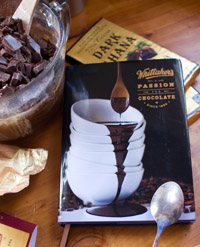
Whittaker’s Passion for Chocolate
By J. H. Whittaker & Sons Ltd · Reviewed by Andy Heyward

The very instant I picked up this book I wanted to eat it. The book is so sumptuous looking I was tempted to lick the pages. The rich chocolatey brown and sepia tones, coupled with the golden inlay and type, made me feel like Charlie from Charlie and the Chocolate Factory carefully peeling back the cover to show a hint of gold below. Holding and reading this book is a treat in itself, let alone actually making the recipes.

Whittaker’s Passion for Chocolate boldly declares in its introduction that it has been over 100 years in the making. It begins with the family history, starting in England in 1890 and moving through the generations of family involvement to the present day – the company having operated in New Zealand since 1896. There is the story of chocolate and handy tips on choosing and melting chocolate, but what I really want to do is get stuck into the recipes.

The book features recipes from some of New Zealand’s finest chefs as well as selected submissions from its extensive Facebook fan base, including a tried and true fudge recipe by our very own Ana Lydiate, also known as Ami Ana.

Choosing what to make is difficult as it all looks so good. The generous and beautifully photographed recipes make it so much harder. If you have any type of chocolate addiction this book will make you salivate uncontrollably and, a bit like a Labrador dog watching you eat a chop, drool will slide out of the side of your mouth as you turn each page.

As it was my mother’s birthday, I decided to invite her to dinner and make a couple of recipes out of the book. I came across a recipe by chef Marc Soper which I decided to make as a main. I had great pleasure in announcing that I was creating lamb rump with rosemary-infused Whittaker’s Dark Ghana sauce, served with carrot and mango julienne, green beans, turnips and olive and grape salsa.

Not having a lamb rump on hand I substituted it for a leg of lamb and set to making this dish – it turned out delicious (and not too difficult) with many compliments from my family, the kids especially smitten with putting chocolate sauce on their meat. For pudding I chose to make an equally tasty chocolate and raspberry brownie by submitter Jo Knowles. Served with whipped cream and fresh coffee, this went down well and earned good-son points for me.

Whittaker's Passion for Chocolate

Whittaker's Passion for Chocolate

More than just a recipe book that gets put on the shelf, Whittaker’s Passion for Chocolate sits equally well on the coffee table and will lure the wary into a path of chocolate desire, containing enough history and facts to make a casual and informative read and enough recipes – ranging from marbled chocolate meringues and cinnamon cardamom blondies to white chocolate and macadamia cheesecake – to satisfy the hungriest of chocolate lovers.

Watch out chocolate-induced coma – here I come.

Andy Heyward is Director of Possibilities at Fat Spatula. A graphic artist, he also paints as a creative release from his other serious and stressful positions of being President of the Haumoana Lemon Marketing Board and founding member of the Haumoana Men’s Knitting Club.

Home Sewn: a Kiwi design story

Friday, January 4th, 2013

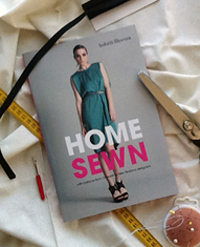
Home Sewn
By The New Zealand Fashion Museum · Reviewed by Jo Drysdall

I still remember the thrill of being allowed to look through my mother’s wardrobe of home-sewn clothes when I was a little girl. Being allowed to touch the fabrics and try on the odd piece was a formative experience in retro dress-ups, I think. As a fashionable young woman, my mother had sewn most of her own outfits: party frocks with fitted bodices and flared, flirty skirts, neat little shift dresses, and tailored, timeless Chanel-style suits.

Home Sewn begins with a brief historical overview that places these homemade treasures in their Kiwi context, making the point that in New Zealand (until, arguably, the last quarter of the twentieth century) if stylish, individual clothes were desired, most women had to make them for themselves.

It goes on to capture the stories of ten contemporary New Zealand fashion designers and highlight the beginnings of their careers. Each designer offers a design from their collection as a pattern included in the book.

While some of the designers featured in this book (and the accompanying exhibition) found their passion for sewing at high-school or design college, many first learned their skills at home – from mothers or grandmothers, making dolls’ clothes or outfits for themselves, friends or siblings. Their backgrounds illustrate this point again and again, presenting stories of home-grown talents that will no doubt resonate with many in the Felt community.

For me this book underlines my feeling that a passion for innovative, quality clothing design and construction can be born and nurtured in many places other than a tertiary course, though these courses certainly have their valued place. It also makes the welcome suggestion that there is room in the New Zealand fashion scene for these varied origins – and the interesting and innovative approaches to fabric they tend to foster.

The patterns provided by the ten featured designers are offered as inspiration for readers to express their own “creative individuality,” rather than as templates, which is perhaps the reason they’re only drawn in the 10–12 size range. Because of this, I couldn’t recommend this as a book for the beginner – while some good tips are offered on construction and finish, there is no guide to fitting or resizing (despite the rather context-less inclusion of a basic diagram on taking measurements) and the compact pages of pattern instructions assume a basic skill set. However, that said, it is actually quite refreshing to find a dressmaking book that is pitched at more experienced seamsters.

Home Sewn is published to coincide with the Home Sewn exhibition from the New Zealand Fashion Museum, currently touring New Zealand. In 2013 you can see the exhibition at the following venues:

Whangarei Art Museum
17 December 2012 – 17 February 2013

Dunedin Art Gallery
9 March – 7 April 2013

The Dowse Art Museum
10 August – 24 November 2013

Jo Drysdall has a variety of alter-egos, running the gamut from librarian to corsetiere, fabric artist to horticulturalist. When not facing identity crises she enjoys ogling books on textile art and vegetables.

Creating memories

Monday, November 5th, 2012

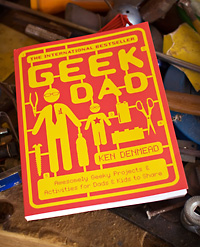
Cover of Geek Dad: Awesomely Geeky Projects & Activities for Dads & Kids to Share

Geek Dad: Awesomely Geeky Projects & Activities for Dads & Kids to Share
By Ken Denmead · Reviewed by Andy Heyward

I always judge a book by its cover and this cover appealed to me in a blokey, nostalgic sort of way. The orange and yellow colour scheme reminds me of the old electronic user manuals I would find lying around my own dad’s workshop. He was a sparky for the power board and would have countless, unfinished repair jobs on the go to poke around and explore. Some of my fondest memories of childhood are doing projects with my dad, making rubber-band guns out of wood and wire, giving his racing pigeon transport boxes a unique paint job, building a shed to fill with shelves of old power-tools and parts. He was also the person who introduced me to Star Wars, taking me to see each movie as it was released. It was our father-son treat, which continued with all the latest re-mastered movies and my own kids in tow.

So when I saw this book needed reviewing I jumped at it. I believe I am qualified because: a) I am a dad, and b) having grown up with Star Wars, computer games and an eighties fashion sense I am probably a geek on some level.

Gathering my 11 year old, we flicked through the book together to see what projects appealed. The first thing I noticed about Geek Dad is that it isn’t meant to be read from front to back. You are meant to skim the projects, pick one and then dive on in. The projects are separated into general areas, making it easy to choose if you want a crafty project, an outdoor project or something with electronics and so on. The projects range from making compost bins to creating an outdoor movie theater, from making Lego props for home cartoons to making a kite you can fly at night. There is a good range of projects to suit all budgets, skill levels and interests. Most of the projects don’t take too long, and you can easily modify the ideas to suit what you have on hand. I found myself reading through a project and thinking of what would be cooler to add, or what could I use this with and wondering if anyone would notice if we rigged this up in the fridge…

Interior spread of Geek Dad: Awesomely Geeky Projects & Activities for Dads & Kids to Share

Interior spread of Geek Dad: Awesomely Geeky Projects & Activities for Dads & Kids to Share

Geek Dad is a starting point for doing projects, an excuse to hang out with your kids and vice-versa. It’s not so much the task or the project but the “doing” that is the fun part and what is remembered long after the object has bitten the dust. The book is a good prompt for us big boys to remember to do things with our children, whatever it may be, and start creating memories for our own kids to pass on. This book would make an ideal gift for the blokes in your life with kids aged 5 to 15 years or for dads who need to work less and play more.

Anyway I am off to modify a Lego car that is due to do battle in a demolition derby with my son in the arena of impending doom.

Andy Heyward is Director of Possibilities at Fat Spatula. A graphic artist, he also paints as a creative release from his other serious and stressful positions of being President of the Haumoana Lemon Marketing Board and founding member of the Haumoana Men’s Knitting Club.

Delicious and doable

Monday, October 22nd, 2012

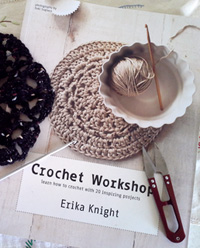
Cover of Crochet Workshop by Erika Knight

Crochet Workshop
By Erika Knight · Reviewed by Jess Soutar Barron

There’s something delicious about an object that abides by the rule of form following function BUT ALSO is beautiful and useful. Books that are thoughtfully designed to work in a practical sense, and inspire in a more abstruse one, are precious because they are the reason why the internet cannot take over completely, libraries will not fade away, bookshelves will always be needed. They are more than vehicles through which to disseminate information. They are a beautiful thing in themselves, an object as precious as its contents. More than the medium being the message, the medium is a treasure in itself.

Erika Knight’s Crochet Workshop delivers its message well – stepping readers through 20 projects from the first slip-knot to the final loop-through. BUT ALSO it is lovely to touch, carefully considered in its design – down to the cover that slides into the book as a page saver – satisfying to explore. With a nod to the design aesthetic of Sibella Court, Crochet Workshop is themed in subdued tones with careful staging and pared back props. It hints at a simple life without preaching. The book is so subtle in its styling that it is the antithesis of the craft porn we crafters find in such books as Loani Prior’s Wild Tea Cosies, sophisticated hoopla in a cacophony of colour.

Interior spread from Crochet Workshop by Erika Knight

Interior spread from Crochet Workshop by Erika Knight

For some the styling may be a tad too restrained and not at all showy enough, certainly not something to aspire towards, for its patterns and projects are far too achievable, although for the beginner it is perfect: easy to follow, step by step, satisfying in its ability to guide users from conception through construction to actual completion (unheard of in some tomes). But for those who admire Nicky Gabriel over Daina Taimina this is a must have, especially if you’ve always wanted to learn the fine art of hooking. More Debbie Bliss than Debbie Stoller, Crochet Workshop is delicious inside and out – even if you have no intention of actually making any of the projects, it will still look stellar on your occasional table (hand-crocheted doily (p.116) or no).

Jess Soutar Barron is one half of the dynamic duo behind Hawke’s Bay’s fledgling craft empire Coco and Co and the fabulous Fruit Bowl Craft Jam.

A Guide to Natural Housekeeping

Monday, September 10th, 2012

Cover of A Guide to Natural Housekeeping by Christina Strutt

A Guide to Natural Housekeeping
By Christina Strutt · Reviewed by Katy McRae

Christina Strutt’s A Guide to Natural Housekeeping is your classic, entry-level handbook on how to tread lightly upon this earth. It’s not the sort of thing a survivalist would include on their compulsory reading list, but it does touch on a wide range of topics in its quest to encourage you live a greener existence.

Christina introduces the book with an apology: “If my tone wanders from technical to bossy, from stating the patently obvious to the downright cross, I apologise here and now. I have become an ‘eco-worrier’, but worrying is no bad thing when it comes to saving our environment.” It’s an apology worth remembering because the book does oscillate a bit between some good old-fashioned wisdom on housekeeping and some fairly alarmist statements. My personal favourite: “We are in a perilous state and unless we all react and understand the situation TODAY, we will be leaving our children and grandchildren a world of chaos, catastrophe and disaster . . .”

This may well be true. Some might say we are already living in a world of chaos, catastrophe and disaster . . . but it does seem a little at odds with her comments further along in the book, like her one on the value of having matching hangers. ‘Begin with matching hangers. A well-organised, presentable wardrobe will make life a million times easier and it will be a pleasure to choose from.”

A million times easier? Really? Had I known I would have done that years ago.

But in all seriousness, Christina is undoubtedly very passionate about the environment and while she clearly has a row to hoe, she does warn us upfront what to expect.
 
Double page spread from A Guide to Natural Housekeeping by Christina Strutt

Double page spread by A Guide to Natural Housekeeping by Christina Strutt
 
She has also produced a really handy guidebook that might just make you think twice about using that chemical cleaner. I’m going to have to be living in a post-apocalyptic world before I will contemplate inflicting the honey and fennel face pack on myself. However, her section on ‘The Usefulness of Herbs’ is, as described, very useful. Similarly, her chapters on ‘Keeping House’, ‘Energy for Life’, ‘The Kitchen Garden’, ‘The Well-stocked Larder’ and ‘Inspired Gifts’ are packed full of handy hints and clever ideas. She mixes grandma’s advice with some newer ideas and innovations to create a really useful resource that you’ll be reaching for every time you want a refresher on the many benefits of bicarbonate of soda (and believe me, there are many). And, as you would expect from the woman behind the fabric, fashion and interior design company, Cabbages & Roses, the book is a very pretty read.

Katy McRae likes formica tables, sharp scissors, fabric (especially felt), strong-smelling solvents and words. She also likes to make stuff. She’s not a fan of the colours peppermint and royal blue.

Homespun Style

Monday, August 27th, 2012

Cover of Homespun Style by Selina Lake
 
Homespun Style
Selina Lake · Reviewed by Rose Wells

Having recently purchased our first home, I was keen to see what Homespun Style by Selina Lake could offer in the form of decorating advice. There are lots of great ideas, and the mantra of working with what you have, rather than replacing with brand new, fits the small budget that goes with having just bought your first home.

Divided into three sections, the first describes the elements that go into a room, with detail on modern craft, colour and pattern and how to customise and recycle pieces you find. The “Details” section goes over textiles, lighting and display, while “Spaces” goes in depth into the different areas of the home – there is even a section for creative spaces. I liked the liberal of use of candles and holders, but the suggestion of open shelves to store your crockery had limited appeal after all the tremors here in Christchurch!

Inside spread from Homespun Style by Selina Lake

Inside spread from Homespun Style by Selina Lake
 
Homespun Style is a great source of inspiration for those who can’t help adding to their collection of op-shop finds. It’s full of tips on how to show off your finds and use things in unusual and decorative ways, and there are plenty of gorgeous photographs to inspire you to create your own homespun style.

Known for her beautiful scented candles and familiar to many Felt regulars as the friendly voice of our support desk, Rose Wells is now devoting her time to freelance graphic design and building her candlemaking empire, Rose in Thorns.

A Girl’s Guide to Decorating

Monday, August 13th, 2012

Cover image of A Girl's Guide to Decorating by Abigail Ahern

A Girl’s Guide to Decorating
By Abigail Ahern · Reviewed by Katy McRae

Abigail Ahern is a British interior designer, stylist and owner of one of London’s leading interiors stores. And now she’s added author to her list of achievements with A Girl’s Guide to Decorating.

As you would expect from a woman with such a reputation for style, this is one good-looking book. Beautiful photography is matched with clean, clever layout to create 190 or so pages of eye-candy. Even if you didn’t read a single word, the pictures alone would give you a good half hour of inspiration. And the paper stock is classy – I like that in a book.

Luckily Abigail can also write…which is a huge relief because there’s nothing more disappointing than a book that’s all fluff and no substance. Her mantra, if you will, is that “style has absolutely nothing to do with money” and she sets about proving her case in what is effectively a decorating how-to, packed with hints, tips and tricks of the trade.

Abigail has divided the book up into the basics of interior design – glamour, colour, texture and light – prefaced by a chapter on planning your space and ending with a chapter on ‘practical stuff’ (tools you’ll need and techniques to master). She covers everything from painting floorboards to hanging wallpaper, but specialises in ‘entry-level’ DIY which gives you the biggest bang for your buck. It’s all about giving things a lick of paint, arranging collections in clever ways, swapping the handles on your furniture (“one of the easiest ways to change the look of your furniture”) and making the most of your space rather than bashing down walls or ripping out your kitchen.

Double page spread from A Girl's Guide to Decorating – Abigail Ahern

Double page spread from A Girl's Guide to Decorating – Abigail Ahern

She also has nifty sections within each chapter where she goes into all the different options and what they’re best suited for – wall and floor surfaces, styles of curtains, shelving, options for cabinets, different types of wallpaper and so on. This woman knows her coving from her cornicing and now, thanks to her, I do too.

My only slight criticism would be that she does, at times, have a tendency to state the blindingly obvious. Case in point: “displaying personal treasures…gives a home a heart and soul.” Or my personal favourite, “paint is a great way to spruce up walls without blowing the budget”. But I can forgive her the occasional banal comment for all the good advice she then goes on to give.

As with all of these sorts of things, the closer you are in taste to the author, the more you’re going to get out of the book. DesignSponge describes Abigail Ahern’s style as mixing “eclectic elements while having fun, but not going overboard – very modern, but still so liveable.” If that sounds like your cup of tea, then this is a book for you.

Katy McRae likes formica tables, sharp scissors, fabric (especially felt), strong-smelling solvents and words. She also likes to make stuff. She’s not a fan of the colours peppermint and royal blue.

Crafty Girls’ Road Trip

Monday, July 30th, 2012

Crafty Girls' Road Trip by Ann Packer

Crafty Girls’ Road Trip
By Ann Packer · Reviewed by Anne Mortimer

In 2004, my copy of Ann Packer’s Crafty Girls’ Road Trip was well thumbed and had its own permanent place on my dashboard as I travelled the length and breadth of the country. It encouraged many a small diversion and certainly helped me to spend my way around New Zealand, single handedly boosting the economy. The guide proved to be indispensable – wherever we went, the guide went too, as my craft oracle (or crutch). Inevitably as time went on, some shops disappeared, but I never lost faith in the guide. It was a happy day that I read that a completely new and updated version had been published and an even happier day when I received a copy to review.

The new guidebook is a much more substantial proposition. For one thing it’s a darn sight heavier than the previous version, which I think is due to the beefier weight of paper, a slightly larger format and more pages to include more entries as well as ten simple, quick and easy craft projects to tempt you. The basic premise of the guide remains the same: a hearty offering of craft places throughout the country, laid out region by region. The selections include craft shops, studios, op shops, retro and antique shops as well as tried and tested places to stop for a break to fortify your mind and body before you embark upon further treasure seeking.

Ann does comment about some places having gone and shares with the reader what finds she made at various places including “I had a fantastic day finding blankets and other quiltable stuff last time around, but not this time”. Certainly so much of the enjoyment gained from a crafty road trip is the possibility of finding some fantastic treasures so it does all come down to being at the right place at the right time.

If I have any criticism, it is that some of my favourite places from the previous guide that are still alive and well were missing. This may have been due to space limitations, or to keep some of the gems a little bit secret. It was heartening to see that Christchurch had a good number of entries, with important information on where places have relocated to. Due to space and time constraints crafty girls seeking more information on vintage, op shop and markets would do well to visit Diana Clark’s website fromtheuniverse.org

The Crafty Girls’ Road Trip offers a snapshot of craft places throughout the country as a starting point for all of us crafty girls to add to. Take it on your own road trip but don’t forget to try it out at home too, you’ll never know what you might discover on your own doorstep or through your browser thanks to the handy dandy resource guide that’s helpfully included at the end. Time to plan a crafty girls’ road trip – who’s with me?

Anne Mortimer is a sometime mum and sometime administrator. She also makes handcrafted felt items and will occasionally sell these. Anne has worked for museums, galleries and libraries in the UK and settled in New Zealand three years ago.